


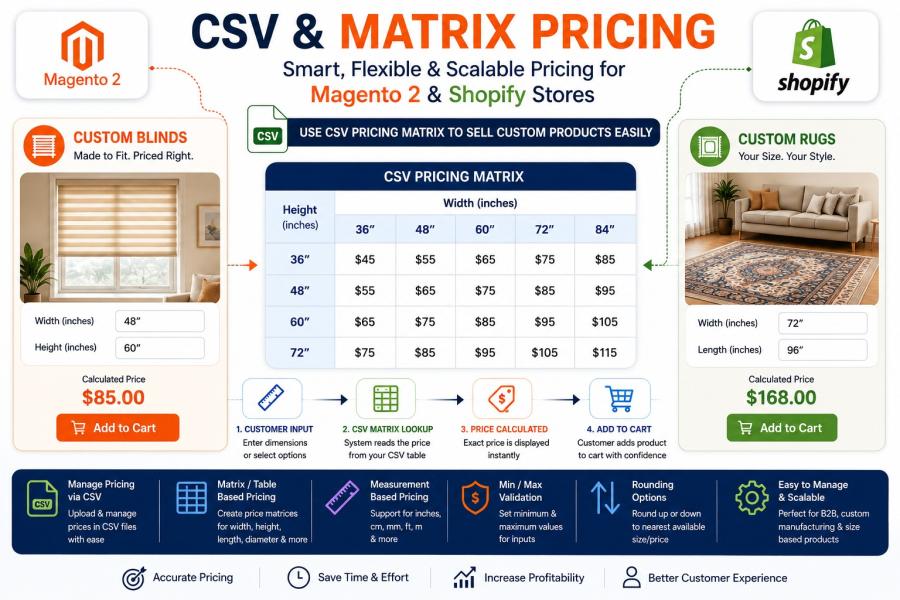
Product pricing is simple when every product has one fixed price. It becomes much more complicated when the price depends on size, dimensions, measurements, or customer selected options.
Think about custom blinds, rugs, carpets, wallpaper, banners, canvas prints, window coverings, sheets, tarps, artwork, and similar products. A customer may need a specific size that does not make sense to create as a separate product or variation.
Creating hundreds or thousands of product combinations can make catalog management difficult and can also make the buying experience harder for customers.
CSV based matrix pricing provides a different approach. Instead of creating a separate product for every possible combination, merchants can maintain pricing information in a structured CSV file and use that data to determine the appropriate price.
This approach is useful for both Magento 2 and Shopify stores, although the implementation and available features can differ between the two platforms.
What Is CSV Matrix Pricing?
CSV matrix pricing is a way of maintaining product prices in a structured table instead of creating a separate product or variation for every possible combination.
For example, imagine a store selling custom blinds. The price may depend on width and height. Instead of creating hundreds of products for different sizes, the merchant can maintain the pricing in a matrix.
The customer enters the required measurements and the pricing system uses the available pricing data to determine the applicable price.
The same concept can be used for rugs, carpets, wallpaper, banners, canvas products, window coverings, and many other products where the final price depends on dimensions.
For businesses already maintaining pricing in Excel or CSV files, this can also provide a familiar way to manage pricing without making the product catalog unnecessarily large.
Why Magento 2 Stores Need a Better Approach to Custom Pricing
Magento 2 is well suited to stores with complex catalogs and advanced pricing requirements. However, creating a large number of product variations just to represent different measurements can quickly become difficult to manage.
For example, a store selling custom rugs could have hundreds of possible width and length combinations. Creating a separate product for every combination would increase catalog complexity without providing much value to the customer.
MageArray's CSV Table Matrix Pricing extension for Magento 2 provides another way to manage this type of pricing.
Merchants can create a CSV file containing prices for different sizes and upload the pricing data for the required product. Pricing can also be managed through global configuration when the same pricing structure needs to be used across products.
The extension supports measurement units including millimeters, centimeters, inches, feet, and meters. It can use customer entered measurements to determine the applicable price.
Magento 2 CSV Pricing Example
Consider a store selling custom wallpaper.
The merchant may have thousands of possible width and height combinations. Creating individual products or variations for every combination would make the catalog unnecessarily complicated.
With CSV based pricing, the merchant can maintain the pricing structure in a spreadsheet.
The customer visits the product page, enters the required measurements, and the pricing system checks the configured pricing data to determine the applicable price.
Minimum and maximum values can be used to prevent customers from entering measurements outside the supported range.
This gives the merchant more control over the pricing process while allowing customers to configure the product according to their requirements.
Managing Magento 2 Pricing Without Complicating the Catalog
A major advantage of matrix pricing is that the product catalog does not need to contain every possible pricing combination.
This can be useful for businesses selling:
- Custom blinds
- Rugs and floor carpets
- Wallpaper and wall covering materials
- Banners
- Canvas prints
- Artwork
- Sheets and tarps
- Windows and coverings
- Other products where price depends on dimensions
The Magento 2 extension can also work with existing custom options. Store owners can configure labels for measurements such as width and height, use text fields for customer measurements, or provide available selections where appropriate.
Depending on the configuration, the calculated pricing can be used with the product's regular or special pricing setup.
CSV Pricing for Shopify Stores
The need for flexible product pricing is not limited to Magento 2.
Shopify merchants can face the same challenge when selling products where the final price depends on dimensions or customer selected specifications.
For example, a Shopify store selling custom blinds may need to calculate pricing according to width and height. A rug store may price products according to length and width. A printing business may need pricing based on the size of a canvas or banner.
In these situations, a standard product price does not always represent the way the business actually sells the product.
A CSV based pricing solution can connect the merchant's pricing data with the information entered by the customer.
How CSV Based Pricing Works on Shopify
MageArray has developed a Shopify solution for businesses that need CSV based custom product pricing. While the Shopify implementation is different from the Magento 2 extension, it is designed to solve the same core business problem: managing structured pricing data and calculating the right product price based on customer requirements.
Merchants can upload their CSV pricing data and configure it at the product level or use a global or group based pricing setup when the same pricing structure applies to multiple products.
For products where the price depends on measurements, customers can enter values such as width, height, or length through text fields. The pricing system uses those values together with the configured CSV data to determine the applicable price.
Minimum and maximum values can also be configured to help prevent customers from entering measurements outside the range supported by the business.
The calculated price is displayed on the product page before the customer adds the product to the cart. The CSV calculated price becomes the final product price shown to the customer.
The calculated price remains associated with the product in the cart and is also reflected during checkout.
The Shopify solution also supports custom product options and additional pricing for selected options, giving merchants more flexibility when a product requires customer supplied information along with measurement based pricing.
Product Level Pricing
When different products require different pricing structures, CSV pricing can be configured at the product level. This gives merchants control over how individual products use their pricing data.
Global and Group Based Pricing
When multiple products share the same pricing structure, merchants can use global or group based configuration instead of maintaining separate pricing data for every product.
Measurement Based Pricing
Customers can enter measurements such as width, height, or length. The system uses those values to determine the applicable price from the configured CSV pricing data.
Price Calculation Before Add to Cart
The calculated price is shown directly on the product page, allowing customers to understand the price before adding the product to their cart.
Pricing Through Cart and Checkout
Once the customer adds the configured product to the cart, the calculated price remains associated with the product and is carried through to checkout.
Shopify Theme Compatibility
The Shopify solution has been implemented on different Shopify themes and has also been tested with the latest Shopify theme. This allows the pricing functionality to be integrated into existing Shopify storefronts without requiring merchants to rebuild their store around the pricing system.
Magento 2 vs Shopify for Custom Product Pricing
Magento 2 and Shopify are different ecommerce platforms, but merchants on both platforms can face the same pricing problem.
The important question is not only which platform a business uses. It is how the business determines the price of its products.
If a product has one fixed price, standard ecommerce pricing is usually enough.
If the price changes according to dimensions, measurements, options, or a pricing matrix, a more flexible pricing solution may be required.
Magento 2 gives merchants extensive control over catalog and pricing logic. This can be particularly useful for businesses with complex ecommerce requirements.
Shopify provides a managed ecommerce environment, but stores selling custom or measurement based products may still require additional pricing functionality.
On both platforms, the goal is the same: make it easy for customers to configure what they need while giving the merchant control over how the price is determined.
Why a Pricing Matrix Can Be Better Than Hundreds of Product Variations
There are several practical reasons to consider a matrix based pricing model.
Smaller Product Catalogs
You do not need to create a separate product or variation for every possible measurement.
Easier Price Management
Pricing information can be maintained in a structured CSV file instead of manually updating a large number of product combinations.
Better Customer Experience
Customers can enter the measurements they actually need instead of searching through hundreds of variations.
Better Control Over Valid Measurements
Minimum and maximum values can help prevent customers from entering measurements that the business cannot produce or fulfill.
Flexible Pricing
Different prices can be maintained for different sizes and measurements.
Suitable for Custom Products
The approach works particularly well for products that are manufactured, cut, printed, or priced according to customer requirements.
What Happens When the Customer's Measurement Is Not in the Pricing Table?
This is an important consideration when using matrix pricing.
Suppose the pricing table contains a price for 100 cm and another price for 110 cm, but the customer enters 105 cm.
The pricing system needs a defined rule for handling that measurement.
For Magento 2, the pricing configuration determines the available pricing values that can be used for the product. Merchants should structure their CSV pricing data according to the measurements they want customers to be able to purchase.
For Shopify, the same principle applies. The CSV pricing data should contain the measurements and prices that the merchant wants to offer through the store.
Custom Validation for Measurement Based Products
Custom products often have practical limits.
A manufacturer may only produce blinds within certain dimensions. A printer may have a maximum canvas size. A flooring company may have minimum order dimensions.
Allowing customers to enter any value without validation can result in incorrect orders or unnecessary manual communication.
CSV based pricing can help address this by defining acceptable measurement ranges.
For both Magento 2 and Shopify, minimum and maximum values can be configured to help keep customer input within the range supported by the business.
The customer can therefore receive useful feedback before adding the product to the cart.
When Should You Consider CSV Matrix Pricing?
A CSV or matrix based pricing solution may be worth considering when:
- The price changes according to width.
- The price changes according to height.
- The price depends on length or area.
- The product is manufactured according to customer measurements.
- You already maintain pricing in Excel or CSV files.
- You have too many product variations.
- Customers frequently request custom dimensions.
- Your sales team spends time calculating prices manually.
- Your existing product pricing does not accurately represent how your business sells the product.
A Better Experience for Both Merchants and Customers
Good ecommerce pricing is not only about displaying the correct number. It is also about making the buying process easy to understand.
Customers should be able to enter what they need and see a price that makes sense.
Store administrators should be able to maintain pricing without creating an unnecessarily complicated catalog.
That is the main idea behind CSV matrix pricing.
For Magento 2 merchants, MageArray's CSV Table Matrix Pricing extension provides a practical way to manage measurement based pricing through CSV data and product configuration.
For Shopify merchants, MageArray can also provide a CSV based custom pricing solution that can be implemented according to the store's product structure and pricing requirements.
From Magento 2 to Shopify, the Pricing Challenge Is the Same
Magento 2 and Shopify have different architectures and different ways of handling product data, but the business requirement can be very similar.
A merchant wants to sell a product that cannot be represented by one fixed price.
The customer wants to enter the required specifications.
The store needs to determine the correct price.
The merchant needs a practical way to maintain the pricing data.
CSV and matrix based pricing can connect these requirements and reduce the need to create large numbers of unnecessary product combinations.
Need CSV Based Custom Pricing for Your Store?
If your Magento 2 store sells products based on dimensions, measurements, or matrix based pricing, explore MageArray's CSV Table Matrix Pricing extension.
If you are running Shopify and need CSV based custom pricing, MageArray can help implement a solution based on your store's requirements. The Shopify solution is available for custom implementation today, even before the public Shopify product page is released.
Contact MageArray to discuss your custom pricing requirements.
